Configure once. Distribute to everyone.
Available on Small Team and Team editions, settings sharing pushes error-detection rules and cloud-storage connection parameters out to every member of your team. Senior engineers do the configuration; everyone else inherits the result instantly.
All features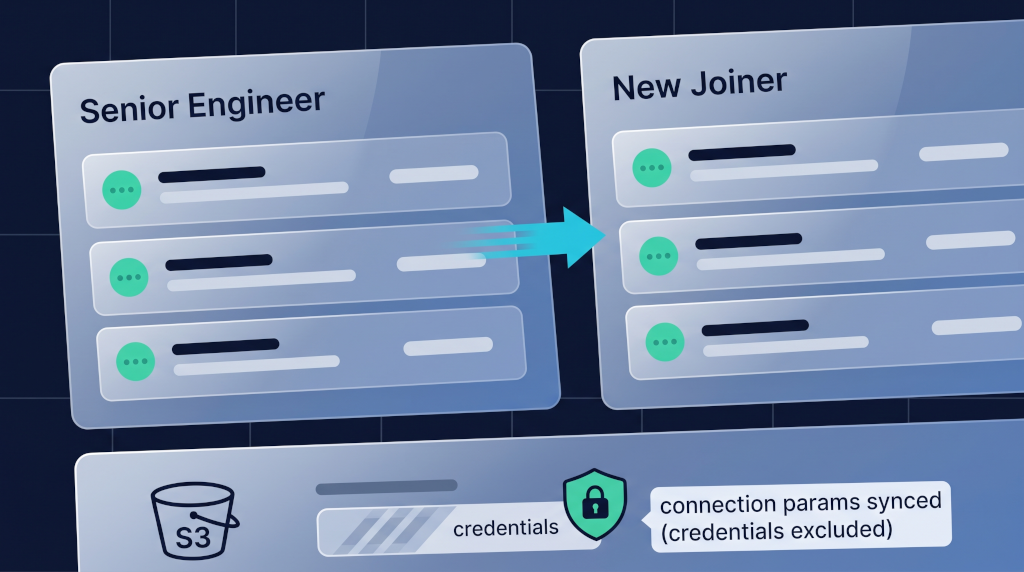
Two things you only want to write once.
Event Classification Rules
The rules engine that marks failures in the analyzer. A senior engineer encodes the patterns that took years to learn, every junior gets them automatically. More on rules.
Cloud Storage connection parameters
Bucket name, region, endpoint URL, prefix conventions, everything except credentials. Each team member still authenticates with their own AWS access key, but the connection target is centrally managed.
Connection parameters yes. Access keys no.
webQsee deliberately does not share AWS access keys across the team. Each member uses their own credentials, which they create in their own AWS IAM. The team config tells the extension where the bucket lives; it doesn't tell anyone how to access it.
Two reasons. First, security, central shared credentials are an audit nightmare. Second, traceability, every S3 operation is attributable to a specific IAM user, so you know exactly who uploaded which capture.
What's shared, what isn't
| Bucket name | |
| Region / endpoint | |
| Prefix conventions | |
| Rule definitions | |
| AWS access key ID | |
| AWS secret access key |
Invite, remove, audit.
A dedicated Team Settings UI handles the lifecycle: invite new members by email, remove members when they leave, see who has access to what. Invited members inherit the team's plan, the Cloud Gallery, the longer recording limit and the shared rules, for as long as the invitation is active, with no subscription of their own.
Push a rule update and every team member's webQsee picks it up on its next sync. No "did you remember to install the new ruleset?" hand-waving.
Two roles matter in practice: a Super Admin manages the team itself, and a Content Admin may create and edit the shared rules. Everyone else consumes them.
Use case
Senior engineer creates rules. They've spent a decade learning the patterns that mean trouble in your stack. They codify them as webQsee classification rules with fix instructions attached.
Juniors get them instantly. Next time anyone on the team captures a session, the same patterns light up red with the same explanation and the same suggested fix.
Onboarding shrinks. A new hire's first day already includes a decade of pattern recognition.
Small Team and Team editions.
Settings sharing requires a multi-seat plan, that's Small Team (5 members, owner included) or Team (10 by default, raised on request). Solo Professional users get personal rules and a personal Cloud Gallery, but team distribution kicks in once there's an actual team to distribute to.
See plansStop guessing. Start webQseeing.
Add webQsee to Chrome or Edge in one click. Most features are free, forever, no signup needed. Upgrade only if your team needs cloud sharing, S3 storage and Pro-grade tooling.
Works in Chrome 103+, Edge 103+ and most Chromium-based browsers. Install instructions.